


Years ago, I spent a summer as a lifeguard. I remember the training more than the hot summer afternoons. Hour after hour, an instructor drilled us on how to reach someone who was struggling in the water without both of us going under. Good intentions were not enough. If I jumped in without training, I would have become a second person who needed saving.
That lesson has stayed with me from then on. Wanting to help someone is a fine starting point. Knowing how to help them is a different skill altogether, and it has to be learned on purpose. Paul put it plainly in Galatians 6:2: “Carry each other’s burdens, and in this way you will fulfill the law of Christ.” Carrying a burden well takes strength you build ahead of time, not strength you hope shows up in the moment. That’s the question behind this article. If you’re weighing a psychology degree because you want to help people, what does the training actually look like?
This article walks through seven required classes inside Grace Christian University’s Bachelor of Science in Psychology, so you can see exactly what fills the classroom hours in the psychology program.
What Is a BS in Psychology at Grace Christian University?
A Bachelor of Science in Psychology at Grace is a 120-credit undergraduate degree that studies human behavior, development, and mental health through a biblical worldview. The major itself requires 45 credits across 14 courses, alongside a 30-credit general education core and a 30-credit Bible and theology core.
The program description in Grace’s academic catalog puts it plainly: psychology “goes beyond diagnosing and treating mental illness.” Students learn to use research ethically to improve people’s lives in the context of family, work, and everyday life. The program also uses a bio-psycho-social-spiritual model, meaning students learn to look at a person’s biology, thinking patterns, relationships, and faith together, rather than treating any one piece as the whole story. That approach lines up with something the American Psychological Association has emphasized in its own guidelines for undergraduate psychology programs: strong programs build both scientific thinking and communication skill, not just theory recall. Grace adapted its own program outcomes directly from those APA guidelines, then added in a biblical foundation at the core of all the classes.
The 7 Courses

Below are seven required courses from the psychology major, arranged in the order most students take them. Each one adds a different skill, and together they form a fairly complete picture of what it takes to help someone well.
1. PSY 201 – Introduction to Psychology
Every psychology student starts here. The course covers the principles, methods, and major theories that explain human behavior, and it gives students a shared vocabulary they’ll use for the next four years. In this class students are taught how psychology applies to everyday life and ministry. A student who wants to counsel someday and a student who wants to lead a nonprofit both start from the same base of knowledge here.
2. PSY 245 – Lifespan Psychology
Helping someone well requires knowing where they are developmentally. A ten-year-old, a new parent, and a grieving widow all process life through different developmental lenses, and this course walks through those stages from conception to death. Students study several major theories, including psychodynamic, behaviorist, cognitive, and ecological models, and compare how each one explains growth and change. The course also stresses something important: two people at the same age can develop in very different ways because of temperament, personality, and circumstance. A future counselor who understands that difference will listen better than one who assumes every client fits a textbook pattern.
3. PSY 310 – Abnormal Psychology
This course teaches students how mental health conditions get classified, described, and understood. It looks closely at the neuropsychological factors, social influences, and environmental conditions that contribute to conditions that fall outside typical behavior. For a student aiming toward human services or counseling, this class removes a lot of the mystery and stigma around mental illness. Understanding depression, anxiety, or trauma as conditions with real, studyable causes changes how a future helper responds to someone in crisis.
4. SOC 255 – Introduction to Human Services
Good intentions only go so far without knowing how the system works. This course introduces students to human services in both public and private settings, including the history of the profession and the local resources available to people in need. Students complete site observations as part of the course, paying close attention to factors like socioeconomic status and differences in power that shape a client’s experience. By the end, students start to test their own interest in a human services career against the reality of the field rather than an idea of it. That kind of early clarity saves students years of guessing later.
5. PSY 349 – Theories and Foundations in Counseling
This is where theory starts turning into skill. Students study major personality and counseling theories, with attention to the frameworks most commonly used in the United States. The course includes assertiveness training and self-reflection, along with role play and case studies that let students practice common counseling responses with other people in the room. Students also examine their own personalities and reactions, which matters more than it sounds. A counselor who doesn’t understand his own triggers will struggle to stay calm and useful when someone else is in distress.
6. PSY/MIN 457 – Counseling and Coaching Seminar
This seminar takes a biblically integrated approach to counseling and coaching, built for ministry settings as well as traditional helping professions. Students learn basic conversational and coaching skills, then build a model for combining those skills with a Bible-centered approach to helping others. This is one of the clearest examples of how Grace’s psychology program differs from a purely secular one. Students don’t set their faith aside to learn counseling technique. They learn how the two work together, which matters a great deal for graduates headed into church ministry, Christian counseling settings, or any workplace where they want to serve people out of genuine conviction rather than a script.
7. PSY 420 – Psychology Internship
The internship is where everything gets tested against reality. Students complete a faculty-supervised placement at a local agency, with a minimum of 40 hours of contact time for every credit earned. A typical placement runs three credits, which comes out to at least 120 hours working under agency supervision, though students can complete additional credits and hours based on their placement. During the internship, students take classroom concepts and theory and apply them to actual situations. They also complete additional coursework alongside their supervising faculty member to keep connecting what happens in the field back to what they learned in the classroom. Most students describe this course as the point where the program started feeling like a career.
What Makes Grace’s Approach Different
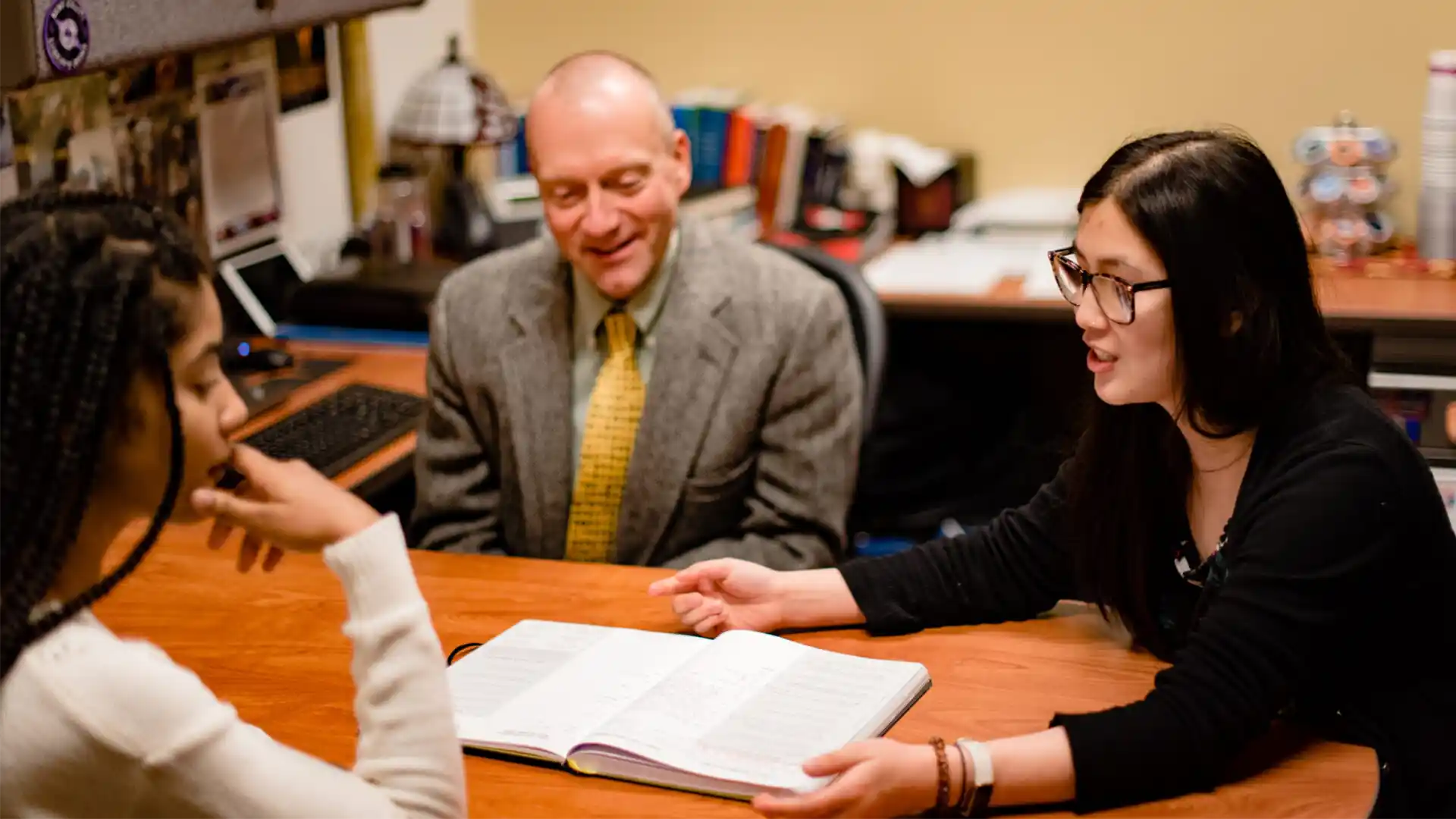
Many psychology programs provide a strong foundation in research, theory, and clinical concepts. At Grace Christian University, students study psychology through a Bible-centered perspective. They examine the science of human behavior while remaining grounded in the truth of Scripture and the belief that every person is created in the image of God. This foundation helps students recognize the God-given value and dignity of each person as they prepare to serve and care for others. That shows up practically in a program built around small classes, where a professor can actually track a student’s growth over four years instead of a semester. Kyla T., an on-campus psychology student, put it this way:
“The Psychology program at Grace Christian is eye-opening. The professors are great , very encouraging. It’s one-on-one, with wonderful internship opportunities and amazing guest speakers. Going into a mental health field can be heavy, so I wanted faith incorporated into my career. That’s what drew me to Grace.”
— Kyla T., on-campus psychology student
That kind of mentorship has a name and a face on campus. Dr. Scott Shaw, Assistant Provost and Online Psychology Professor at Grace, holds three doctorates spanning conflict management, health psychology, and educational leadership. His students remember him less for his credentials than for how he treats them. One psychology student, Renae, recalled the standard he sets in class:
“Dr. Shaw reminds us that we’re called to uphold our values and show Christ’s love through our actions, kindness, and morals.”
— Renae, psychology student
That perspective is part of what students experience throughout the Psychology program at Grace. Faculty encourage students to connect what they are learning with their faith and consider how they can reflect Christ in the way they understand, serve, and care for others..
Where This Degree Can Take You
A bachelor’s degree in psychology can lead to more career paths than many students expect. However, it’s important to understand which careers require a bachelor’s degree and which require additional education. According to the U.S. Bureau of Labor Statistics, social and human service assistants work directly with clients in areas such as psychology, rehabilitation, and social work. They may work for nonprofit organizations, social service agencies, government organizations, and other community-based settings. The median annual wage for social and human service assistants was $45,930 in May 2025.
A psychology degree can also prepare graduates for opportunities across human services, community organizations, education, business, and other fields. In fact, federal data on psychology degree holders shows that people with psychology degrees work across a wide range of occupations. Management accounts for 15% of employed psychology degree holders, followed by community and social service occupations at 13%, education at 12%, healthcare at 11%, and business and financial operations at 10%.
Careers That Require Additional Education

Some career paths require additional education and licensure. Substance abuse, behavioral disorder, and mental health counselors, for example, have different education requirements depending on the role. Mental health counselors typically need a master’s degree and an internship. These counselors earned a median annual wage of $59,350 in May 2025. Employment in this field is projected to grow 18% from 2025 to 2035, with about 50,500 openings projected each year.
Becoming a psychologist also typically requires an advanced degree. According to the BLS, psychologists earned a median annual wage of $99,110 in May 2025. Overall employment of psychologists is projected to grow 6% from 2025 to 2035, with about 11,300 openings projected each year. For students considering graduate school, psychology also provides a strong academic foundation. BLS data on psychology graduates shows that 62% of employed psychology degree holders work in occupations that require at least a bachelor’s degree. In addition, 51% of psychology degree holders have earned an advanced degree. The numbers point to an important distinction. A bachelor’s degree in psychology can prepare students to begin serving in a variety of professional settings. It can also provide the foundation for graduate study for those who want to pursue careers such as counseling or psychology that require advanced education and, in many cases, professional licensure.
Who Is a Psychology Degree Right For?
Grace’s Psychology program may be a strong fit for students who want to better understand people and help others through difficult seasons of life. It’s designed for students who are curious about human behavior and want to study psychology from a Bible-centered perspective that recognizes the God-given value of every person. The degree can also provide a strong foundation for students considering graduate study in counseling, social work, psychology, or related fields. Students build knowledge in areas such as human development, counseling, research, and psychological theory while preparing for what may come next.
Students should also know that psychology involves more than counseling. Research and statistics are an important part of understanding human behavior and evaluating psychological research. Students who want to pursue careers that require professional licensure should also plan for additional education after earning their bachelor’s degree. Requirements vary by profession and state, but careers such as licensed counseling and clinical psychology typically require graduate education and additional steps toward licensure.
Knowing those requirements early can help students choose a path that supports both their career goals and the ways they hope to serve others.
Frequently Asked Questions
Can I become a licensed counselor with a bachelor’s degree in psychology?
A bachelor’s degree in psychology alone does not qualify you to become a licensed professional counselor. Licensed mental health counselors typically need a master’s degree, supervised clinical experience, and state licensure. A bachelor’s degree in psychology can prepare students for entry-level opportunities in human services while also providing a foundation for graduate study in counseling, psychology, social work, or related fields.
Is Grace Christian University’s Psychology program accredited?
Grace Christian University is institutionally accredited by the Higher Learning Commission (HLC) and is also accredited by the Association for Biblical Higher Education Commission on Accreditation (ABHE). These accreditations apply to the University rather than serving as a separate professional accreditation specifically for the Psychology program.
How many credit hours does the B.S. in Psychology require?
The Bachelor of Science in Psychology requires 120 total credit hours. The current program includes 30 credits in the General Education Core, 30 credits in the Bible and Theology Core, 42 credits in the Psychology major, and 18 credits of undesignated electives or a minor. Degree-completion transfer students may have different Bible and Theology Core requirements.
What is the Psychology Internship?
The Psychology Internship gives students an opportunity to apply what they have learned in the classroom in an approved agency or professional setting. The internship is faculty supervised and helps students connect psychological concepts and theory with practical experience. Internship requirements and placement options can vary, so students should work with their academic advisor when planning this part of the program.
Does Grace’s Psychology degree combine psychology with a biblical worldview?
Yes. Grace approaches psychology from a Bible-centered perspective and a bio-psycho-social-spiritual understanding of the person. Students study the biological, psychological, social, and spiritual factors that influence human behavior while remaining grounded in Scripture and the belief that every person is created in the image of God.
Courses such as PSY/MIN 457, Counseling and Coaching Seminar, help students connect counseling and coaching skills with a faith-based approach to serving others.
What jobs can I pursue after earning a bachelor’s degree in psychology?
A bachelor’s degree in psychology can prepare graduates for entry-level opportunities in human services, nonprofit and community organizations, social services, and other fields where understanding human behavior and working with people are valuable. Specific education and experience requirements vary by employer and position.
Students who want to become licensed professional counselors, clinical psychologists, or pursue other licensed mental health careers should plan on additional graduate education and professional licensure.
A Psychology Degree at Grace
Helping people well requires more than good intentions. Students need to understand human behavior, development, relationships, research, and the challenges people face. At Grace, that education begins with another important truth: every person is created in the image of God and has God-given value. Throughout the Psychology program, students learn to understand and care for the whole person from a bio-psycho-social-spiritual perspective. They develop their knowledge of psychology while learning from professors who encourage them to remain grounded in Scripture and consider how their faith influences the way they serve others.
That preparation reflects Grace Christian University’s mission of Graduating Courageous Ambassadors for Christ Who Make an Eternal Impact Wherever They Go. Psychology graduates can carry that foundation into human services, community organizations, graduate programs, churches, and other places where they have opportunities to serve and care for people.
If you’re considering a Psychology degree at Grace, schedule a campus visit or connect with our Admissions team to learn more about the program.


