


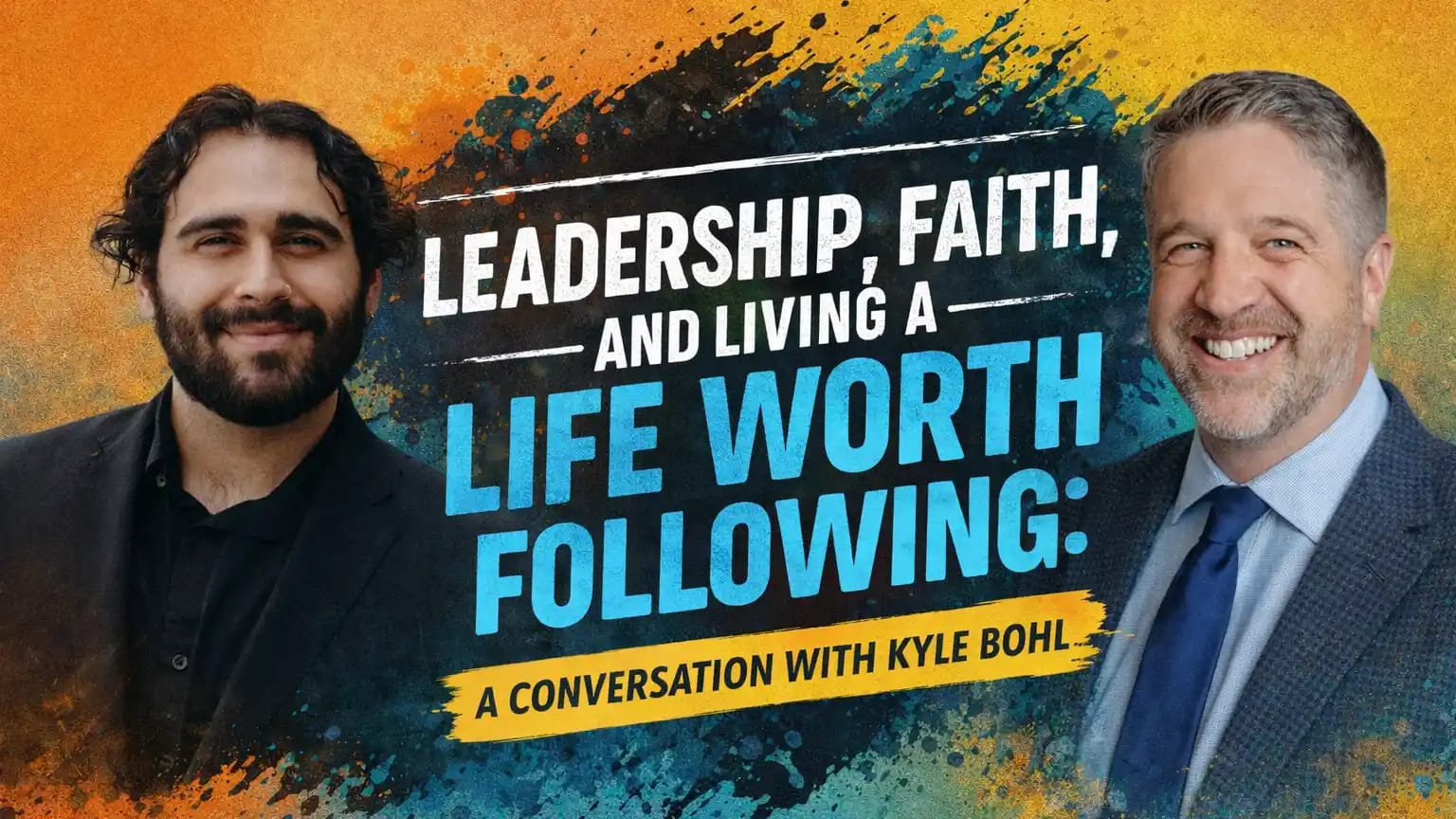
An in-depth interview exploring the intersection of Christian leadership, student development, and Living a Life Worth Following at Grace Christian University and beyond.

From Basketball Player to Spiritual Leader
Danny: So you came here for basketball, right? That was your motivation. What changed? Because now you’re here as my boss, we work together, you’re a friend and mentor, and you still work closely with the basketball team. What brought you to this point?
Kyle: I tell students all the time, somewhere between my freshman and sophomore year, I would say that I was a basketball player who happened to go to Grace. And somewhere along the line, through chapels and small groups and theology and Bible classes and my education classes, just being in this space at Grace Christian University on these grounds, I turned into a student at Grace who happened to play basketball.
So there was a huge heart flip there, and that’s what I challenge young people who are here at Grace to do, embrace the process. We’re going to talk about process probably a lot today, but embrace the process because what it does is it creates and helps to shape and mold you to launch.
Grace as Destination and Launch Point
This is a destination for a freshman, but it’s only a launch point for a junior or senior. At some point, that flips and you start to utilize Grace as your destination. Then, as you mature spiritually, mentally, physically, the whole wellness wheel of health, all of a sudden, you’re ready to launch and then you go.
I have found that God has called me to be in this place to walk with students for four or five years because this is the time where I learned to launch. I came to Grace as a young man who knew what I believed, I had a good foundation, but didn’t know how to share it. I would lean away from hard conversations. Now I lean towards hard conversations because of the foundation that Grace has given me. And now I can hopefully help lots of students doing the same.
The Joy of Leadership Through Hard Conversations
Danny: We’ve talked about this before, but there’s a sort of joy that comes with leadership where you get to work with somebody on the hard stuff in life. Sometimes that comes from a hard conversation, a hard situation, or even an opportunity where someone needs to fail safely. They get an opportunity to grow and try something out, and maybe it didn’t go the way they expected to, but it’s a learning opportunity that they then get to grow in and learn that process and be launched into life. There’s a trust being built there with you and the student, but also with yourself and your abilities in leadership to say, “God has called me to do this thing, and I get to do this.” It’s exciting to see growth even in the hard stuff.
Kyle: I would say it’s not about me at all. I’m a vessel. God’s asked me to do this, and I’m just trying to steward it in a way that honors Him.
Students as Chapter Books
I love to think of it this way: Every student is a chapter book. Their time at Grace Christian University is a chapter or two, and I get to be a footnote. They’re the hero of their story. I might help them as a puzzle maker, I might help them to build their puzzle, but in the end, the story is about them, and I might have a little spot at the bottom that says, “This guy at this little time helped in this little way.” If that’s what I can do, then I feel like I’m stewarding the role well.
Danny: It’s about empowerment, right? You’re not the main character. You’re trying to assist others. I think that’s a biblical principle that even Christ presented. He talks about that in Matthew 20:28, where He says, “I did not come to be served, but to serve.” He shows it with His actions, washing the feet of His disciples, presenting Himself in a way where even though He’s the guy, He’s demonstrating the example we need to live out. That is the standard of a leader we should be following. Paul said, “Follow me as I follow Christ,” but the big point there is follow Christ. He is the one who sets the ultimate standard.
Stories of Transformation
Danny: You get some really unique opportunities in your position where you get to walk with students. Can you share some examples or moments in your time here where you’ve seen Christ working in the lives of students?
The Basketball Captain Who Found His Path

Kyle: In my first role as a part-time coach back in 2005, I was an assistant coach for the men’s basketball program. I was walking with a captain who was getting some grief from his teammates because he was going to a bunch of events and was a leader on campus. He came in before practice with tears in his eyes and said, “Hey, I need to ask you a question. Why are these guys messing with me? And what should I do about it?”
I sat him down on the bench as guys were warming up, and I said, “Listen, you are living a full life. Don’t stop what you’re doing. Don’t allow some guys that want to be on the fringe, who have chosen to take pieces and parts of this culture, but not all of it, to deter you. Follow your heart. You are currently living a full life, and you will continue to live a full life, and you’re building habits right now for the rest of your life.”
He is now a pastor at a mega church in Detroit, absolutely serving people in a way that honors Christ every single day, navigating family life and being the best husband you’ve ever seen. It’s not to say that choosing to go to events at Grace is the reason why he’s that, but he created the habits of a full life while here doing those things, stretching outside of his comfort zone. Walking with him was a joy.
When God Turns the Mess into the Message
Here’s another really powerful example. In 2012, I became full-time as Dean of Students. In one of my first years, I had a student who wasn’t ready to be at Grace. In my role as the judicial affairs officer, I had to make some tough decisions. Through the process, we ultimately decided that he wasn’t a good fit at that point to be at Grace.
Just a couple months ago, I had a phone conversation with him. He said, “Kyle, getting kicked out of Grace is the best thing that’s ever happened to me. It’s the reason why I found Christ.” He didn’t say yes to Christ here, but the foundation that was given to him, even when he was not desiring it, went into his heart. After I sadly had to remove him from campus, he found Christ, he got sober, he found his wife. They’ve got four beautiful kids living down South, and he’s part owner of a company. Now he’s giving back to Grace in a financial way because he believes that getting removed from Grace was the reason why he knows Christ today.
I was part of a tough part of his journey, but him sharing that just allows me to see that God can use any scenario and situation for His betterment. I’ll probably say this again today, but God takes the mess and makes it the message eventually.
Trusting God’s Plan in Community
Danny: I think we often understand that leadership can be hard, there are challenges, but God is working in those situations. We need to do the best we can with the tools that God has given us and the opportunities that are presented, and continue to grow in those skills. But ultimately, whether it’s something with a hard conversation or something that’s exciting and joyous and awesome, God can use any of those situations and still bring someone who didn’t know Him to a relationship so that lives are changed forever.
Someone else might have the same experience and leave saying, “I hate this school, I have nothing to do with God.” Whereas someone who has the same experience realizes, “Wow, God really did this for me to put me in a place where I can now live my life in the fullness of His spirit and glorify Him and exalt Him with the gifts that He’s given me.”
Kyle: Exactly. We have to trust that God is in the inner workings of our community because there are people that I won’t be able to reach even though I desire to. There are things of affinities and different factors that would probably allow God’s pathway to intersect with somebody else instead. We have to trust that God has placed people in those students’ paths.
We need to be as coordinated as we can so that no student slips through the crack. We have to trust and be faithful that God’s plan is big and we don’t know that plan. We have to be faithful in the opportunities that He gives us and then trust that He will give others the same opportunities with other students that we don’t have.
Danny: It goes back to what you were saying, it’s not about us. It’s about God. We have to put ourselves not on the pedestal but put Him on the pedestal for people to look to Him.
Evolving Leadership Roles
Danny: Your position has grown and developed. Now you are the Associate Vice President of Athletics and Student Affairs. You’re working in a different capacity than you did as Dean of Students when you were really heavily, directly involved. What does the position look like now in terms of how you interact with students and influence student leaders?
From the Ditches to the Structure
Kyle: My previous roles allowed me to have direct interaction without trying. I was in the ditches. I was working with student government, working with RAs, navigating judicial situations, part of athletics, coaching, mentoring. Now my role is more to create the structure and the vision and core values of the different departments that I serve.
I get to hopefully create opportunities for others to have those transformational experiences with students. I can cascade that to people like you so that you can have 16 people on the hospitality team for Chapel that you can be pouring into. My role now is to empower you, to pour into you and others, to ensure that you’ve got a full cup to do so.
It’s really turned into impacting the same amount of students, but I don’t have near the amount of face-to-face interactions with students as I once had. That kind of hurts the heart once in a while because that motivates me, to see someone work through something difficult and to be part of their story is fun.
Finding Connection Points
But you have to take opportunities where you can. One of the things I’ve tried to do the last few years is serve as the team chaplain, we call ourselves team connectors, for our men’s basketball program. Once a week I get to do a devotional live in person with them. Our coaches give me 25 to 30 minutes once a week to have very strong interpersonal dialogue where we’re working through things. That has scratched the itch of making sure that I’m still part of the solutions that students desire to have, and I’m not just in the background building teams and making sure that we have healthy ways to do things at Grace.
It’s been a new challenge and one that I’ve had to wrestle with a little bit, to be very honest. To watch you and others continue to serve students at a high capacity fills my heart. And sometimes I get a little envious.
Multiplication of Leadership
Danny: You still get opportunities, but it’s not as much as in the past. But you’re still doing it in a way where you have some voice in it because you have a past with athletics, with basketball. This is the whole framework you’re talking about, essentially divide and conquer and putting people in place, empowering them. You’re empowering us as leaders, and we empower our interns and people who are in leadership positions, students who are in leadership positions, so that they can pour into others. This is multiplication of leadership. We use the same framework with evangelizing, you make a disciple and that disciple makes two disciples and you continue on. It’s the same thing with leadership, with mentoring, pouring into others and doing it in a way where the whole thing isn’t on you, it’s not on one person, but it’s on a community of people who are walking alongside each other with the same mission, same goal, different gifts, different ways you can speak to somebody in their lives. Which I think is the way that God meant it to be so we can impact people in those specific ways.
Inverting the Leadership Triangle
Kyle: I think some people, a lot of people probably see leadership as a triangle, and leadership means you’re at the top of that point. But we want to invert that triangle so that the point is at the bottom. The leader’s at the bottom raising up the leaders who are then going to go and change student lives and things like that. So it’s really about serving those that are on your teams.
I often say, with the more titles you have in life, the less life is about you and it’s more about those you serve. We’ve seen that from leaders at Grace, they all have one mind about that, where the more titles you have, less is about you and more is about your serving.
Understanding the Why of Leadership
Danny: We’ve talked about students wanting to become something, they’re coming to college to grow and get a position and pursue a career. A lot of times before they can do that, we try to help them understand their why. Why are you doing this? What’s the purpose? What’s the goal intended? Why do you find joy in going for this? I think we can do the same thing with leadership. Why is leadership important? What’s the significance about it? What do you think is important about leadership and how it influences people?
Kyle: When I first started attending church and getting involved, I didn’t grow up in the church, I started being encouraged by my youth group leaders and youth pastor to seek after ministry and be involved in that way. One of the best pieces of advice, or the most formative advice that was given to me early on, was that a leader’s success is shown in the way that they lead their ministry or team to fend for themselves, essentially. How can a ministry or organization continue on or flourish whether or not that leader did what they needed to do? Would it be autonomous?
Danny: What are your thoughts on that in leadership, and how do we do that here with students who are continuing to be cycled through?
Building a Culture That Outlasts You
Kyle: I think it goes back to culture. If you, as a leader, can help to build a culture that can perpetuate itself and be healthy, it can survive the ups and downs of someone coming or going. If a president of a university or an organization or corporation leaves and that organization slumps, that leader didn’t empower the people or build the culture or mechanics for that company to thrive when they’re gone.
I think the sign of a good leader is if you have a very important person who leaves, can the organization, can the student body, can whatever entity continue to flourish without them? Oftentimes we think, “Oh, that leader’s going to leave, what are we going to do?” Well, I think if that leader was worth their salt, they set up the mechanics so that when they’re gone, the place continues on like nothing ever happened.
That goes back to culture being built and making sure that you are hiring the right people, recruiting the right students, and building the mechanisms to ensure safety, wellness, and thriving.
Counter-Cultural Leadership
Danny: I think it still goes back to what you were saying, it’s not about us, right? Empowering others so that they can be lifted up. I see in culture, in my own generation, a desire for that, a want to be the person, the influencer, the CEO or head of something. Maybe it has to do with pride or greed, maybe it’s all personal depending on your influence. Social media influence is huge with my generation, with the younger generations, wanting to be that kind of person who does it all or is the go-to. But when it comes to leadership, and I would say a biblically-based, faith-influenced leadership, a gospel-centered leadership, it’s flipped upside down. It’s not about me, it’s about others, those around me. That shows the success of your leadership. It’s so counter-cultural to what we’re seeing.
The Rudder Beneath the Water
Kyle: If you go hear a really solid business CEO or a university president, you’re going to hear, “It’s not about me, it’s about the people.” It’s really fun to sit with leaders, to learn from them. The thing that I come back to most is, yes, a leader needs to have a face that can be put on a billboard once in a while—that is a thing. Every boat needs a rudder. That leader is that rudder, but that rudder’s underneath the water. You don’t see the rudder.
Every boat that is not sinking looks beautiful on the outside and it goes fast, but what’s keeping that boat afloat and turning in the right direction and going the way that you want it is because of a rudder underneath the water. That leader shouldn’t be seen a lot.
I look at leaders and think, it’s about the others. Let’s prop everyone else up. One of my thoughts about leadership is that I want to make sure that others have my podium. I have the role to be able to grab the mic whenever I want, but I don’t. I want others to grab the mic and I want others to stand on stage and I want to prop others up so that we can build up leaders. If I get hit by a bus, there’s somebody that’s going to slide right in and keep it going and move it forward.
Leadership Without a Title
Danny: A lot of students, a lot of young leaders, they’re not in a leadership position just yet. A lot of times they’ll step into an opportunity because they feel called to, whether it’s ministry or an organization or whatever it may be, or a team. They want to step into a position where they see an opportunity to grow and develop and they want to become that leader, but they don’t have that title yet, they’re not in charge. What kind of advice would you give? Because we see that all the time. What kind of advice would you give to somebody who’s in that position where they could be a leader but they’re not in charge?
Kyle: The thoughts I have are not flashy, okay? And they’re going to rest on people like, “Oh, really, that was his answer?” But here it goes. I think that the foundation for leadership is to answer the question: Am I living a life worth following?
In my time alone, who am I? Do I have a process in place to help me get to the end result? Or do I just want to get to the end result? Because I guarantee you never will.
Spiritual Disciplines and Continual Improvement
I often ask people, if someone’s applying for a job or to be an RA, “What are your spiritual disciplines? What are you focusing on in process every day?” Here’s some coach speak: continual gradual improvement daily. If you’re going after continual gradual improvement daily in your life, you’re thinking about your wellness wheel, you’re thinking about spiritual work every day. You’re thinking about physical work every day. You’re thinking about emotional work and cognitive work every day.
The things that nobody’s going to see is what’s going to make you a leader. Because you have to go through the fire of the process. A marathon runner doesn’t show up for a marathon without training.
The Magic Hour
Are you waking up? I talk about the magic hour. There’s books written about the magic hour. It’s 5 a.m. to 6 a.m. What are you doing at that time? Are you utilizing that time to make yourself better?
One of the things that I love to do is get an early workout and read the Bible daily. That’s just been in the last year or two that I’ve really focused on that. But I’m telling you, my life, my outlook, my leadership has changed dramatically because I’m investing in self in a way that’s not prideful. It’s like closed door, no one’s looking. I’m spinning on a spin bike downstairs, sweating like crazy at 5:30 when the family’s still sleeping, so that I can give myself to them during the day. While my daughter’s in the kitchen in the morning getting ready for school, I’m at the kitchen table reading my Bible. She sees that every single day.
Just by me doing that is leadership because now my daughter’s starting to ask, “Well, what are you doing, what are you reading?” And it’s super fun to navigate that.
The Test of Integrity
I would say, are you living a life worth following? Will other people see what you’re doing and be like, “There’s something different about that guy. I would want to follow that guy.” At a foundational level, do you live a life worth following? Or do you have secrets? Do you show up and look a certain way one day, but at night, do a different thing?
My dad always used to tell me, “You can fool some of the people some of the time, but you can’t fool all the people all the time.” You’ll always get found out. In leadership, we see so many times where people fall and stumble and get moved out of leadership because of choices they make that have nothing to do with the leadership that they are doing daily, the job that they have that they’re getting paid money to do, but because of the things that they’re doing when they think no one’s looking.
At a foundational level, are you living a life worth following?
Living Like No One Else

Danny: That reminds me of what Dave Ramsey says about finances. He talks to people who are trying to get back on track financially and want to live a financially stable life. He says, “You’ve got to live like no one else to live like no one else.” And I’m like, it goes beyond finances. Finance is one of the things where, of course, that makes a lot of sense. But it goes to character. It goes to leadership. It goes to developing someone who, like you said, is worth following.
Kyle: It starts with that. It’s living like no one else to live like no one else, not in a prideful way, but you’ve got to do the hard things to live a life, as Paul says in Ephesians, living life to the fullness. And that fullness is in Christ. If you can think of the greatest success and fulfillment in life, it’s in Christ. It’s us being hidden in Him, and it starts with our character and our relationship with Him.
The Bible as a Living Document
We’ve known this since Bible times, and yet we don’t follow it well. We’re the same humans with the same sin nature that is plaguing us, but that’s why we’re lucky to have God’s Word that’s consistent and stable so that we can look to that and say, “God says this, and you need to know it.” The Bible needs to be imprinted on your heart. The Bible needs to be a living document in your life daily.
When I read in the morning, I’m reading something I haven’t read maybe since Grace Bible College back in the nineties. I read it again and I’m like, “That has to be totally different” because I’m 44 years old. I’m not 20 years old anymore. The maturity and the life that I’ve had, sometimes I’m not mature, I’ll let my wife tell you that, but the life that I’ve had and the experience I’ve had makes that Bible verse speak differently to me and new to me. As I grow with Christ, my heart is open to the things that He wants to share with me through the Holy Spirit.
The Bible needs to be written on your heart. You need to be able to know these things because as you read daily, God will bring things into your life that explicitly apply to what you read that day. It’s the craziest thing. It’s the most beautiful thing. And it makes me cry every time.
Danny: You don’t realize it until you actually partake in it.
Kyle: It’s hard to describe.
Danny: It’s beautiful. And you experience it. You realize that we can talk about that and say, “I get what you mean by that because I’ve experienced it myself.” And you’re like, “That is what people are talking about. That’s what we want to be a part of. That’s what we want to experience and develop and grow in continuously throughout our lives.” It’s a beautiful thing.
The Incomparable Fulfillment
Kyle: That’s the awesome part about leadership, right? Outside of all the challenges, the tasks, the delegation, the busyness, the fulfillment of being part of God’s plan in another person’s life or in a team or a mission or whatever it is that you’re partaking in. I would say that this doesn’t compare to any other feeling or experience.
Leadership is hard to define, but you know it when you see it. In order to go after it, you need to be in lockstep with Christ. There are a lot of leaders in this world who are not Christian, and I don’t look to them for my guidance. But I’ll tell you, the leaders that I do watch and know live beautiful, full lives because they’re investing in others through God. God is giving them the opportunity and He’s giving me a full cup to do it.
Building Culture
Danny: Let’s say that you are back to day one, whether it’s this position or maybe even college where you were beginning to develop your leadership skills and influence and desire. What would you do differently? Or what would be the first thing you would do if you got an opportunity to restart or re-begin your leadership growing experience?
Kyle: About three years ago, I took over athletics here at Grace. We had an amazing leader for 16, 17 years, Coach Gary Bailey, who was the AD of our athletic department. As he transitioned to a new role away from Grace, our assistant AD Corey Jameson came in. At the same time, Brian Sherstad, passed along the athletic department to me in a transition. Corey and I are both pretty new going, “Okay, what are we going to do?”
The Wisdom to Build Culture
A dear friend, Dave Gruby, was the AD at Grace in the nineties, early nineties, and then he was the AD at Cornerstone for about 20 years. We called Dave and said, “Dave, we’re not starting from scratch because we’re standing on the shoulders of men and women who have come before us for a ton of years since the seventies for athletics. We’ve got hundreds of thousands of alumni, wonderful people. But our story is starting, you know?”
I went to Dave Gruby and had some coffee with him. I don’t drink coffee, but hot chocolate with him. The first thing he said was, “You need to build culture.” Honestly, it took me a little while to understand what he meant by that.
After a couple hours together around the table and living life here at Grace for as many years as I have, we know that mission, vision, core values are the drivers of anything you’re trying to do. It can be a filter or a funnel of the things that we need to do. It makes questions pretty easy when something comes our way. Does it fit the mission? Does it not fit the mission? Does it fit our core values? Does it not?
The Power of Non-Negotiables
If I were to go back to myself in my younger years starting with leadership and say, “Here’s something you should do,” I would look at culture. How are we going to build culture in this place, in this space, whatever it might be? It’s the non-negotiables. It’s coming up with a few simple stated non-negotiables that will drive whatever you’re doing.
Within athletics, we came up with three core values, and for three years now that has driven us so that if I’m hit by a bus, we’ve got three core values that somebody else is going to come in and go, “Well, these are our standards. Does it fit it or not? Yes or no.” We’re going to work hard. We’re going to value others. We’re going to glorify God. If something comes to us, an opportunity comes to us and it doesn’t fit one of those things, we don’t do it. It makes it really easy. It makes a leader’s job really easy. I don’t have to hem and haw over decisions.
Our mission is developing champions for Christ. If something comes to us, here’s a bright and shiny idea, if it doesn’t bring us to fulfilling our mission of developing champions for Christ, then we’re not going to do it. It makes it really easy.
I would tell people or my younger self: develop a culture, and you develop a culture through mission, vision, core values, non-negotiables. Then our job as leaders is to cascade that often so that we inspire the people that we’re serving in leadership so that they catch that feeling. It makes life easy for them.
Navigating Accountability
Danny: I want to talk about that last point you made because that’s a very challenging thing for people to do. When you’re in a leadership position and you’re wanting to be held accountable and experience constructive criticism, to be able to handle failure because it’s going to happen, that’s just the reality of life. What are some tips that someone young and ready to go can prepare themselves for in terms of accountability and navigating accountability?
J-O-Y: Jesus, Others, Yourself
Kyle: I think putting pride aside and being humble. If we can follow in what Jesus has shown as a way to be humble and put others first, we talk about joyful leadership, but joy, J-O-Y: Jesus, others, yourself. That should be the cascading way that you live your life in leadership. Jesus, others, self.
In terms of accountability, I think from my perspective, if you keep the non-negotiables at the front and center, and then if somebody comes up with an idea, if it’s within those non-negotiables, those core values, and it fits budget, why not?
The Coaching Model
When we talk about accountability, specifically at Grace, we use a coaching model. I don’t give you your goals. You give yourself goals. I coach you on those goals. I make sure that they fit within what we’re doing. I might even throw a visionary thought at the end. Then if you feel inspired to do so, you go after it in the way that you want to, in the way that fits your personality and work style.
I think that’s what God wants us to do. I think He might give us a vision and then it’s our job to live through Him and in Him and use our talents, use our passion, use our pursuits to go make it happen. If He wanted robots, He would have made us to be robots. But He gives us each, we’re all imprinted, we’re fearfully and wonderfully made.
Sometimes there is a path that we need to stay on. We can’t get too far right, too far left. That’s where leadership comes in to say, “Here’s the parameters, go after it and stay within the parameters and get to the vision.” Our mission statement is graduating courageous ambassadors for Christ to make an eternal impact wherever they go. When you come up with an idea, does it fit that? Does it get students to go towards that? Does it fit budget? Go.
Finding the Right Analogy
Danny: I don’t know if you have ever played Minecraft before.
Kyle: No, no.
Danny: Okay, so most people will understand this. I’m imagining you as a character riding a pig. You have a carrot that you put in front of them. The carrot is the priorities, the things, the motivation, what you’re going after. The person on top is your mentor, the person holding you accountable, the leader that’s guiding you towards this. And you’re the pig, you’re chasing after that carrot, you’re going after the goal, the motivation, what is first and foremost in what you’re chasing after.
Kyle: The only difference I would say is like a carrot held by the guy riding the pig is almost coercive. It’s like a sneaky thing. At Grace, what I’ve tried to learn from the people that have led me is that it’s your goal because God gave you things that He did not give me. When you took over as director of spiritual offices and team, I said, “I need you to come to work every day thinking about this because I can’t. I don’t have that in me. I’m thinking about these things and I need you.” Hopefully that empowers you to be like, “Yeah, this is mine.”
Danny: There’s no perfect analogy.
Kyle: You could think about it like you’re on a treadmill and you’re running and you have the headband with the carrot. You put it there and you’re chasing after what you’re going. I like these analogies.
The Ultimate Piece of Advice
Danny: I want to finish off with this final question. You meet with students, you’ve had experience mentoring them and empowering them. What is the ultimate piece of advice that you would give? Let’s say that you are sitting with one of those students today and they’re wanting to become a leader. They’re on fire for God, they’re excited. Or maybe they’re even just interested. What is that go-to piece of advice that you want to share with them that is going to hopefully help them in their walk with the Lord and in serving with the gifts that they’ve been given?
Focus on Process, Not Position
Kyle: We’ve already talked about what they have control over, which is hopefully working through spiritual disciplines. What items are they doing in their process? Not thinking about the end goal of being a leader, but working through the process to be a natural leader. You can be a leader right where you sit right now. I don’t think leadership is something you’re born with. I think leadership is something that you are built throughout life through people, places, and environment. I think the people that God has in our lives help us to grow our leadership.
We are leaders when we don’t know it. I’ve got tons of examples of people that said something like, “Hey, I remember this one time when you were talking to somebody and I overheard it, and this is like 10 years ago.” I wasn’t talking to them, but we’re being watched all the time. We need to build our processes daily to work towards it.
Chase Somebody Worth Following
If I were to answer your question specifically about the next step past that, let’s say you’ve got your spiritual disciplines locked on, you’re going, you’ve got your magic hour, you’ve got your time, you’re working with God, you’re praying daily, devotionals, listening to the right music, all those things, you need to chase somebody.
My thought would be, we need to surround ourselves with people who will point us up and outward, not downward. I’m a big believer of mentorship. If someone is like, “I want to learn more about leadership,” you better chase someone that you think is a leader who’s living a life worth following so that you can be in proximity to them because you will just naturally gather from them. Even when you’re not purposefully trying to, it’s not like you’re walking around all day with a notepad, but if they’re going somewhere, go there too.
The Student Must Chase the Mentor
If you know of somebody who you want to follow and you want to get into a purposeful one-on-one, you need to ask them boldly and then chase them. I’ve had students who have asked to be in a mentor relationship with me and then have kind of fallen off. This might sound mean, but I will tell them, “I’m not chasing you as a student. If you would like to be around me, then you’re going to have to do some chasing. I will open up my schedule. I will accommodate and I will go through the hoops that it takes so that we’re in proximity to each other weekly. But if there’s ever a time where that student pulls back, I’m not going to be trying to pull back in.” I’ll check in. I’ll make sure that they’re okay. But in the end, that student or whomever it is should desire it and want it. When you desire that, then you take that on as your own. It’s like, “I’m going to do this because I want it. I’m craving it and desire it.”
Danny: The incentive starts from you.
Kyle: It does. It goes back to your why. Why are you doing this? Then you find that person, that’s the person I want to become or I want to point to. It goes back to what Paul says: “Follow me as I follow Christ.” That’s the whole purpose of mentorship, leadership, and what you eventually step into. But it starts with you doing that. You can’t know how to lead someone unless you’ve been in their shoes. You have to understand from that capacity as well. It’s a whole process of growing, maturing, developing, so that someone can then be influenced by you one day in that same way
Equipped to Live a Life of Purpose
At Grace Christian University, students are prepared to lead with conviction, serve with humility, and live with purpose wherever God calls them. This conversation reflects the kind of formation Grace is committed to, one that shapes lives worth following.