


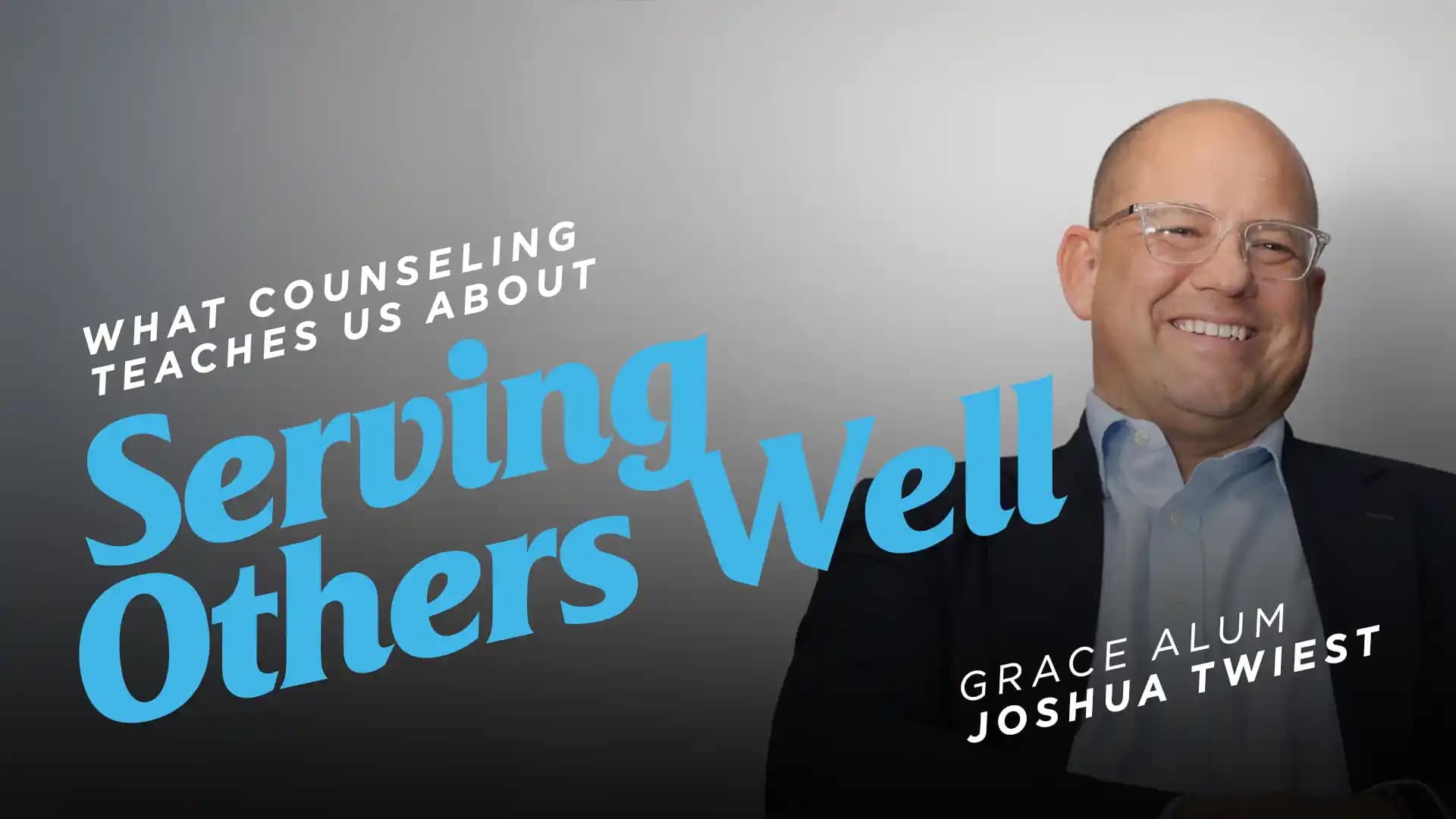
An interview with Army Chaplain Joshua Twiest on faith-integrated counseling, ethical ministry, and holistic care across military and civilian contexts
In this interview, Army Chaplain and Licensed Professional Counselor Joshua Twiest shares insights from a decade of military ministry and private practice. A 2008 Grace Christian University graduate with a degree in youth ministry, Joshua currently serves as a Family Life Chaplain at Detroit Arsenal, discussing the intersection of spiritual care and professional counseling in supporting military families and navigating complex ethical situations. With dual master’s degrees in counseling and program evaluation, along with ordination as a pastor, Joshua brings a holistic approach to helping individuals across spiritual, emotional, physical, and relational domains.
The conversation explores bi-vocational ministry realities, managing professional boundaries with wisdom, and combining clinical excellence with spiritual depth while serving diverse populations in both military and civilian contexts.
The Role of an Army Chaplain
Dawn Rogers: Tell us about your role as an Army chaplain.
Joshua Twiest: I’ve been doing chaplaincy for about ten years for the Army. What I share here isn’t representative of the views of the government or the Army itself. My role is to provide for the religious freedom of soldiers and to serve as a resource for morale, ethics, and overall well-being while offering spiritual support.
At Detroit Arsenal, there are about 6,000 people. It’s myself and a team of two others. I handle a lot of the counseling work. A family life chaplain is a licensed therapist who is also a chaplain, able to support soldiers from both a professional and spiritual perspective. That overlap has been especially meaningful, and people tend to respond well when those two areas work together.
Program Evaluation
Dawn Rogers: Tell me about your master’s in program evaluation. How does that contribute to your roles?
Joshua Twiest: Program evaluation looks at what we’re doing and asks whether it’s actually working. In large organizations, including the military and ministry contexts, we often implement programs with good intentions but without always stepping back to assess effectiveness.
Before coming to Detroit Arsenal, I worked in a primary prevention office in Lansing. That experience pushed me to want a deeper understanding of how programs are designed, implemented, and evaluated. Program evaluation helps determine whether interventions are being carried out correctly and whether they’re producing meaningful outcomes.
It became important for me to understand data and research so I could help improve programs on both a broad level and an individual level. That mindset has carried directly into ministry and counseling work.
Dawn Rogers: That would be incredibly valuable in ministry as well.
Joshua Twiest: Absolutely. I just finished that degree recently, and almost every day I’d learn something I could immediately put into practice. I can’t recommend that kind of learning enough.
Ethics in Ministry
Dawn Rogers: I appreciated that you talked about ethics. There are rules and regulations, but there’s also the spirit behind them.
Joshua Twiest: In order to be effective, you have to have a strong sense of identity. As a chaplain, you don’t just serve people who share your faith. You serve everyone. That means understanding who you are and how to ethically support people whose beliefs or experiences may be very different from your own.
If you don’t understand your identity, it becomes easy for fear, pride, or self-preservation to override good judgment. Ethical questions rarely come up in neat, black-and-white situations. They usually show up in complex, human moments that require discernment.
Dawn Rogers: So no two days look the same?
Joshua Twiest: Absolutely not. Not when you’re working with people. That unpredictability is one of the reasons I was drawn to this work.
Being a Light

Dawn Rogers: Do you hope that the way you live leads people to ask about the hope you have in Christ?
Joshua Twiest: I like to think of it as a journey. I believe the Lord is drawing all people toward Himself. My role isn’t to control that process but to walk alongside someone for a moment, being kind, offering peace, and reflecting Christ through how I treat them.
If I can walk with someone for a short stretch of their journey, I trust that God will continue that work through others as well.
Managing a Private Practice
Dawn Rogers: You also maintain a private practice. What does that look like?
Joshua Twiest: At this point, I work with a small number of clients and prioritize clarity and confidentiality. In the summer, I can meet in nontraditional spaces, and in the winter, we meet online using secure platforms designed for confidential care.
I currently work primarily with children and their parents. When you work with children, you’re always working with the family system too. That dynamic work is challenging but incredibly meaningful.
Dawn Rogers: Do you have a demographic you prefer?
Joshua Twiest: Military families are a group I really enjoy serving. I’ve also found a lot of fulfillment working with families navigating unique or nontraditional dynamics. Helping families better understand themselves and function well together is rewarding work.
Lifelong Learning
Dawn Rogers: Counselors need to be lifelong learners. What does that look like for you?
Joshua Twiest: I tend to use the word helper rather than counselor, because counseling is just one facet of how I serve people. For me, that work has to be grounded in faith and an understanding of the whole person.
I’m especially interested in continuing to learn about physical health, nutrition, and daily habits, because those areas affect emotional and mental well-being. A holistic approach allows us to serve people more faithfully and effectively.
My fear in my own journey is becoming stagnant. Growth keeps us grounded and responsive to the people we serve.
Chaplaincy vs. Counseling
Dawn Rogers: How does your work as a chaplain compare to your work as a counselor?
Joshua Twiest: Someone once told me that every conversation is a counseling session, and I’ve found that to be true. Good counseling skills are really good listening skills, and good listening builds strong relationships.
Counseling is structured. There’s a set time, place, and process. Chaplaincy is much less predictable. A brief conversation can turn into extended care, an unexpected visit, or a need that requires immediate presence.
That flexibility is a defining part of ministry in the military context.
Military Leadership Development
Dawn Rogers: Does leadership development play into this?
Joshua Twiest: The military is one of the strongest leadership development organizations in the world. People are often given responsibility early, and that can be both a gift and a challenge.
Part of our role is helping people grow into those responsibilities at a healthy pace. Some thrive quickly, while others need more guidance and support. Walking with people through that process is a key part of the work.
Advice from 10 Years Ago
Dawn Rogers: If you could go back ten years, what would you tell yourself?
Joshua Twiest: I’d tell myself it’s going to be okay. Trust your calling. Practice gratitude consistently. Gratitude has a way of reorienting your perspective and grounding you, even when things feel overwhelming.
Managing Dual Relationships
Dawn Rogers: How do you manage dual relationships in ministry?
Joshua Twiest: Boundaries are essential. In smaller communities especially, relationships overlap. The key is knowing where those boundaries are and communicating them clearly.
When expectations are clear, trust is protected. Boundaries don’t limit care, they actually make healthy care possible.
Dawn Rogers: I love boundaries. They really are a safety net.
The Role of Family in Counseling

Dawn Rogers: Is there a question you wish I would have asked?
Joshua Twiest: I wish we’d talked more about family. Family systems shape so much of who we are. That’s why my practice focuses on working with children and their families together.
When parents step back and remember the purpose of the family, to support one another and raise the next generation with intention, it often changes how decisions are made and how challenges are approached.
Dawn Rogers: Thank you so much for coming and sharing this.
Joshua Twiest: Thank you. I’m grateful for my time at Grace and for the foundation it gave me.