


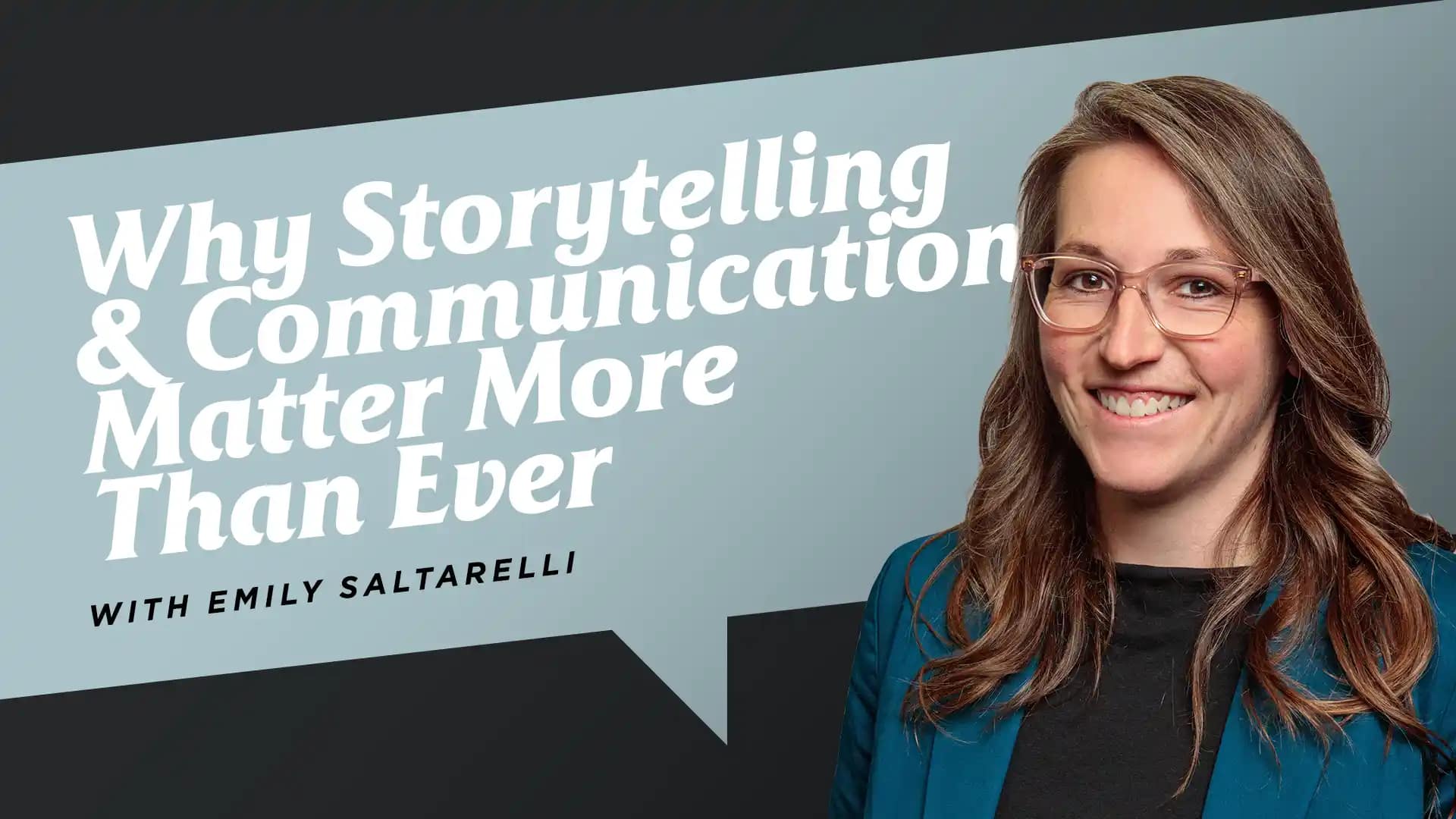
Meeting Emily Saltarelli

Danny Garcia: Emily, thanks for taking the time to sit down and talk with us.
Emily Saltarelli: Glad to be here.
Danny Garcia: To start, tell our listeners what sparked your passion for communication, English, writing, and storytelling.
How writing became part of her life

Emily Saltarelli: I’ve always been a writer. My dad was a high school English teacher, and in seventh grade I had him for both English and history. Every week he required journals, three pages for English and two for history. I wrote five pages a week, and I fell in love with writing because of it. I still have stacks of journals because I never stopped.
Words have always come easier than numbers. My brothers can do math in their sleep. I try to avoid math by sleeping. Writing was the clear fit for me, and I learned that early.
Later, writing became more than a skill. In college, it became a way to reflect on God’s faithfulness. I can look back at old journals and see the hand of God in ordinary days. It became a spiritual practice: reflection, remembrance, and recording what God was doing.
Storytelling, the gospel, and why stories work
Emily Saltarelli: I graduated with a bachelor’s in biblical counseling. I knew I wouldn’t become a professional counselor, but I realized counseling trained me to listen to people’s stories, and writing trained me to tell them well. I moved into freelance writing, then joined a strategic storytelling startup.
At first, I resisted it. I thought, “Why are we telling stories? Why aren’t we sharing the gospel directly?” My boss pushed back and reminded me: stories can show the gospel, not replace it. That changed me.
Jesus told stories. Scripture is filled with stories. Our brains are wired for it, and the research supports it. Stories connect people, help them remember, and move them toward meaning. When we tell stories of what God is doing, we give people something they can carry. Revelation 12:11 connects testimony with the gospel, and that’s not small. Testimony matters.
Why communication still matters in a tech-heavy world

Danny Garcia: In a world of technology and constant communication, why are storytelling and communication still important? Is there a difference between communicating through technology and face-to-face?
Emily Saltarelli: The message and the audience should shape the medium. Some things should never be handled through a text, while other things are fine through a quick message. We know this instinctively.
The medium can send a message on its own. If you choose the wrong mode, you may communicate something you didn’t intend. Technology also speeds everything up. Convenience tempts us to avoid the harder, slower path of real conversation.
Good communication forces us to slow down and think: What am I saying? Who am I speaking to? What’s the right way to say this right now? Communication is more than words. It’s wisdom in delivery.
Why personal stories give people hope
Danny Garcia: Beyond academics and practicality, what makes this personal for you?
Emily Saltarelli: Journaling helped me know myself and my own story. When you know your story, you can hold it with security instead of asking everyone else to hold it for you. You can share it better once you’ve taken time to understand it.
We need each other’s stories. When we tell stories of what God has done, the Holy Spirit places them in the right hearts at the right time. Not every story hits everyone, but someone may hear it and realize they’re not alone. Someone may hear hope and remember God is still good.
Faith-based personal storytelling has faded in many churches. We moved away from testimony rhythms, and we lost something. We need to recover the value of telling each other, in real life, “Let me tell you what God has done.”
Classroom pitfalls and how to get better fast
Emily Saltarelli: One of the biggest issues I see is students reading speeches instead of giving speeches. Reading builds a wall between you and the audience. You stop engaging and stop making eye contact. You stop reading the room.
The fix is practice and better notes. Your outline can have full sentences, but your speaking notes should be key phrases and keywords. If your note cards are full sentences, your brain will read them. Keywords force you to create sentences in real time, which is what speaking is.
Practice feels awkward, mirror practice is brutal, recording yourself is worse, but it changes everything. It makes you look prepared because you are prepared.
Blank moments, authenticity, and why “real” lands
Danny Garcia: What do you tell someone who blanks in front of a crowd?
Emily Saltarelli: Your audience is made of people. They’re rooting for you. They want you to do well because they have to listen to you. Authenticity is a game changer.
If you lose your train of thought, you can say it. “I lost my train of thought, give me a second.” That honesty connects you to the room. You can glance at your notes, reset, or move to the next point. A small hiccup can make you more human, not less effective.
People don’t want fake. Especially right now, people want real people. A polished speech without realness won’t land the way you want it to.
Nerves, character, and speaking from the heart
Danny Garcia: What role does character play in communication?
Emily Saltarelli: Nerves are normal. I still get nervous every time I speak. But the physical response to nervousness is the same as excitement, racing heart, sweaty palms, that stomach flip. You can reframe it: “My body is telling me something important is happening.” You can even say you’re nervous. Audiences are gracious.
But character goes deeper. Scripture teaches that words reveal what’s in the heart. Your mouth will eventually show what’s rooted in you. A tree produces fruit according to what it is. So what are you rooted in? What’s growing in your heart? That will come out in your communication, anger, humility, bitterness, hope, gentleness.
Work on the heart, and the communication will follow. Also, speak what you know. Don’t try to imitate someone else’s personality. Be who God made you to be. People can tell when it’s real.
Learning to Speak What Matters
Danny Garcia: Emily, thank you. This was thoughtful, honest, and deeply needed.